Wrote an article about the guy and two kids who died on the Ozark trail last week.
Read it Here
You may notice I have written a few articles there... That is where most of my writing energy is going these days. I hope to split it and start giving you some good content here also.
Still clinging to my God and my guns,
Randy
Showing posts with label survival. Show all posts
Showing posts with label survival. Show all posts
Wednesday, January 23, 2013


Thursday, March 8, 2012
Selecting a Survival Kit
Author: Gary BentonAs a retired military survival professional, who has instructed thousands of US Air Force aircrews as a Life Support Instructor, I'm often asked a very complex question, "What kind of survival kit is best?" It's not an easy question to answer and for a lot of different reasons. During my military career, which lasted over 26 years and carried me to the four corners of the world, I lived in some very different environments. I've been in the arctic snows of Alaska, jungles of the Philippines, floated in a raft in the Gulf of Mexico, and walked around mountains in the state of Washington. I'm not even considering my numerous camping trips in the deserts of Arizona, New Mexico, or Mexico. Many thoughts go through my mind each time I'm asked this question and I've never really given a good answer, in my opinion.
The individual asking the question is my first consideration. If the person is well experienced in the art of hunting, camping, hiking, or fishing, they will most likely need less gear than an inexperienced person. Hunters who camp are usually the best qualified, in my opinion, because many of them hike to where they hunt, then camp and hunt, which makes them more outdoors qualified. It's important when you're looking for a good survival kit to fully understand your limitations in the field. It's also crucial to be honest and don't make the mistake of thinking you can get by on very little, when you really can't. Additionally, don't confuse comfort with survival, because survival is not a comfy situation. It's being able to do what it takes to stay alive, with what gear you have, and that will mean some discomfort.
Also, the environment you're attempting to survive in has a lot to do with your survival odds. It's easier to survive in a jungle than it is the Arctic Circle, or a burning desert. Each area requires a different survival kit, with the environment considerations as a motivator. In the desert you'll want more water, sun screen, wide brimmed hat, and so on. While in the arctic you'll want gear that will assist you in staying warm, such as hot foods, shelter, and a good sleeping bag. The environment plays a key role in your survival efforts and should always be considered as you assemble or purchase a survival kit. So, keep in mind your knowledge, environment, and gear you think you'll honestly need.
An experienced person outdoors can survive with very little, compared to those without experience. For instance, in most cases, I carry the items listed below and know I can survive for days using the gear.
- A quality penknife or jack knife;
- Good quality first aid kit;
- Plastic whistle – to signal with;
- Two zip-lock freezer bags for water storage;
- Water proof matches;
- Signaling mirror;
- Flint and steel or a metal match;
- Water purification tablets or bleach. I prefer bleach, because it's the best way to purify water;
- A long strip of heavy duty aluminum foil folded up to cook with;
- Fishing kit, i.e., hooks, sinkers, and some line. Nothing fancy;
- Commercial back packing first aid kit (with instructions);
- One small pack of gum and one of hard candy (energy);
You may have noticed, I did not say I would be comfortable during my survival situation. You'll notice the lack of a meal or real food and that's not an important issue for most healthy individuals. We can go weeks without food, but only a limited time without water, depending on the temperature. In the desert, for instance, a temperature of over 100 degrees can kill you in just a few hours, but that also depends on a number of variables. In this article I don't have the space to expand on desert survival.
Now, a good minimum survival kit has: A knife, whistle, magnesium match, signal mirror, water treatment tablets, small fishing kit, compass, and water container of some sort. You can order a good minimum survival kit from the Simple Survival Store, and the prices are pretty low, but if you're like most folks, you'll need a lot more gear than a minimum survival kit.
At Country Sporting Goods you'll find a complete list of survival kits that are sure to meet the needs of anyone experiencing an emergency. The store carries car survival kits, blackout survival kits, emergency survival kits, food and water, and the list goes on and on. The gear is made in the US and not cheap imports, so you know you're buying quality survival gear. All of your survival gear should be the best you can afford and cut no corners in gear quality. Remember, you're betting your life on the survival gear you have with. When push-comes-to-shove, your survival gear is your life insurance policy.
Article Source: http://www.articlesbase.com/camping-articles/selecting-a-survival-kit-5518305.html
About the Author
Gary is a retired E-8, who left the US Air Force after 26 years of service. He taught survival as a Life Support Instructor for over 12 years.
Friday, December 24, 2010
Food security
Can the government keep you from growing food to feed your family?
No?
Think again!!!
Link
Be wary of what big brother finds out about you. Nothing is really safe if they want to take it.
Still clinging to my God and my guns,
Randy
No?
Think again!!!
Link
Be wary of what big brother finds out about you. Nothing is really safe if they want to take it.
Still clinging to my God and my guns,
Randy
Tuesday, December 21, 2010
How safe is your food supply?
With the new of terrorists wanting to hit us in our stomachs, so to speak, how careful are you of what you put in your mouth?
Link
They are hitting real close to home now because my favorite food is buffet. LOL
Once more it brings back how safe are we truly and what are we individually going to do about it?
"God shall supply all my needs" not China buffet or Golden corral.
Get some food security, plant your garden, can, dry, freeze.
Egypt was prepared by God for seven years of famine, do you think it would behove us to at least have seven days of supplies on hand? (try 30 or even 365)
I'll try to weigh in a little more often, when I get my laptop back.
Still clinging to my God and my guns,
Randy
Link
They are hitting real close to home now because my favorite food is buffet. LOL
Once more it brings back how safe are we truly and what are we individually going to do about it?
"God shall supply all my needs" not China buffet or Golden corral.
Get some food security, plant your garden, can, dry, freeze.
Egypt was prepared by God for seven years of famine, do you think it would behove us to at least have seven days of supplies on hand? (try 30 or even 365)
I'll try to weigh in a little more often, when I get my laptop back.
Still clinging to my God and my guns,
Randy
Saturday, November 14, 2009
How to use drags on your traps
Sometimes it may not be possible to stake a trap or tie it off solid.
These are the times that drags cans save your bacon.
If you set your trap in the open a drag will allow your critter to get out of sight from someone who may take it.
If you set your trap in a rocky area you may not be able to stake or have anything to tie it to. A drag will allow you to set your trap in these places.
When I was a youngster, a person could still trap in Colorado. The Colorado trappers association put on a rendezvous every year. They would always have workshops so everyone could learn new things. I went to every one I could.
At one of these an old trapper (I forget his name) gave a demo on drags.
Up to this point I hadn’t used a drag, but after I went I started using them often and have continued to do so for over 20 years.
The premise of a drag is to allow the animal to move and usually they will head for cover and get tangled up.
It will also allow you to hold a much larger critter than if the trap is staked solid since there is some give when the chain is pulled.

The tools of the trade.
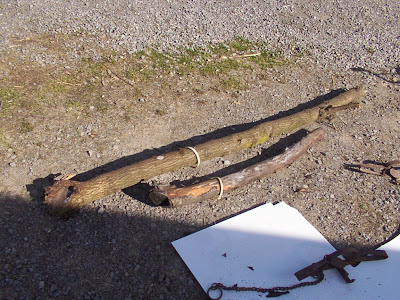
Two logs. The one on the left is 6 ½’ for larger animals, and the one on the right is about 4' for smaller animals.
Two traps. Both are #3 coyote traps but really you can catch about anything in them.
Plain old hardware store wire and a pair of side cutters or lineman’s pliers.
Two snares, a rock and two horseshoes
 Two types of snare swivels.
The one on the left is a McGregor (my favorite type of snare).
I think they are no longer in business; they were out of Roundup, MT.
The one on the right is a 72 Thompson coyote snare.
Since I don’t use store bought drags I came up with this reasonable facsimile.
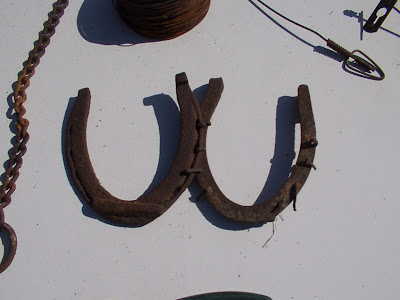
It is two old horseshoes. One still had nails and I put them thru two holes on the other and bent them over.

Wired together well with a single wire.
Then a double strand wrapped around and thru the chain loop.
The loop is passing thru four strands of wire.
When using a drag like this be sure to use a longer than normal trap chain.
This is a newhouse trap with a three foot chain. I would consider that a minimum length for good performance. You want the drag to lag behind when the critter turns so it has a better chance of hanging up and the longer the chain the better. In the first photo you see the trap on the left has a five foot chain and was set up for a store bought hook drag.

I hope you don’t plan on getting your trap back wired like this!!

Double wire thru the chain loop.
This is a very common way to wire your trap to a drag.
It will work but in my opinion is not the best way.

Same double wire around the log.
But now I have added another double wire from the chain loop to the log wire.
This gives you a very good pivot point and allows the log more movement while being drug around.

Here is another very good set up.
If there is a chance your wire could slip off the end of the log, this is the way to go.
A long length of double wire is wrapped around the log, twisted tight, then laid down the log a few inches and wrapped around again.
Then it is tied off.
Then take the short double wire and put it thru the horizontal wire and tie it off.
The next picture shows this hooked to a snare.
Please note that in most if not all places, it is illegal to use a drag with a snare. I include this so you can see how to hold big animals in a survival situation.

This set up with a 72 Thompson snare tied to a 6' pole about 3 dia. held a mountain lion thru 3 hangups.
In each of the hangups the lion cleared a 10-15 foot circle in sage brush.The cable finally gave way.
It was set for coyotes on a trail beside some beaver ponds where we had some sets.
At that time there wasn’t a mandatory check time using killer type traps (connibares, snares and drowning setups) so we checked them once a week. From the tracks it looked like it held for quite a while. I’m more responsible today and in a TSHTF situation checking sets will be a daily exercise.
 I used romex to mark the best place to tie off.
Usually you will want to tie off between 1/4 and 1/3 down the length of the drag . This way the drag runs semi- parallel to the direction of travel and when it catches it will absorb some of the shock as the log springs out sideways.
To use a rock....
 I picked a round rock to show a worse case. Try to pick one with flatter sides if possible.
First make a cradle by taking a long single strand of wire and placing the rock in the middle of it then wrap the wire around to meet on the other side and twist the two together one or two times.
Then go back around in two different places and twist the wire where it meets on the original side then again back around again in a third place and tie off.
It should look something like the picture....
Then take a double wire and tie your chain be sure and go under all 3 wires.
Still clinging to my God and my guns,
Randy
These are the times that drags cans save your bacon.
If you set your trap in the open a drag will allow your critter to get out of sight from someone who may take it.
If you set your trap in a rocky area you may not be able to stake or have anything to tie it to. A drag will allow you to set your trap in these places.
When I was a youngster, a person could still trap in Colorado. The Colorado trappers association put on a rendezvous every year. They would always have workshops so everyone could learn new things. I went to every one I could.
At one of these an old trapper (I forget his name) gave a demo on drags.
Up to this point I hadn’t used a drag, but after I went I started using them often and have continued to do so for over 20 years.
The premise of a drag is to allow the animal to move and usually they will head for cover and get tangled up.
It will also allow you to hold a much larger critter than if the trap is staked solid since there is some give when the chain is pulled.

The tools of the trade.
Two logs. The one on the left is 6 ½’ for larger animals, and the one on the right is about 4' for smaller animals.
Two traps. Both are #3 coyote traps but really you can catch about anything in them.
Plain old hardware store wire and a pair of side cutters or lineman’s pliers.
Two snares, a rock and two horseshoes
 Two types of snare swivels.
The one on the left is a McGregor (my favorite type of snare).
I think they are no longer in business; they were out of Roundup, MT.
The one on the right is a 72 Thompson coyote snare.
Since I don’t use store bought drags I came up with this reasonable facsimile.

It is two old horseshoes. One still had nails and I put them thru two holes on the other and bent them over.

Wired together well with a single wire.
Then a double strand wrapped around and thru the chain loop.
The loop is passing thru four strands of wire.
When using a drag like this be sure to use a longer than normal trap chain.
This is a newhouse trap with a three foot chain. I would consider that a minimum length for good performance. You want the drag to lag behind when the critter turns so it has a better chance of hanging up and the longer the chain the better. In the first photo you see the trap on the left has a five foot chain and was set up for a store bought hook drag.

I hope you don’t plan on getting your trap back wired like this!!

Double wire thru the chain loop.
This is a very common way to wire your trap to a drag.
It will work but in my opinion is not the best way.

Same double wire around the log.
But now I have added another double wire from the chain loop to the log wire.
This gives you a very good pivot point and allows the log more movement while being drug around.

Here is another very good set up.
If there is a chance your wire could slip off the end of the log, this is the way to go.
A long length of double wire is wrapped around the log, twisted tight, then laid down the log a few inches and wrapped around again.
Then it is tied off.
Then take the short double wire and put it thru the horizontal wire and tie it off.
The next picture shows this hooked to a snare.
Please note that in most if not all places, it is illegal to use a drag with a snare. I include this so you can see how to hold big animals in a survival situation.

This set up with a 72 Thompson snare tied to a 6' pole about 3 dia. held a mountain lion thru 3 hangups.
In each of the hangups the lion cleared a 10-15 foot circle in sage brush.The cable finally gave way.
It was set for coyotes on a trail beside some beaver ponds where we had some sets.
At that time there wasn’t a mandatory check time using killer type traps (connibares, snares and drowning setups) so we checked them once a week. From the tracks it looked like it held for quite a while. I’m more responsible today and in a TSHTF situation checking sets will be a daily exercise.
 I used romex to mark the best place to tie off.
Usually you will want to tie off between 1/4 and 1/3 down the length of the drag . This way the drag runs semi- parallel to the direction of travel and when it catches it will absorb some of the shock as the log springs out sideways.
To use a rock....
 I picked a round rock to show a worse case. Try to pick one with flatter sides if possible.
First make a cradle by taking a long single strand of wire and placing the rock in the middle of it then wrap the wire around to meet on the other side and twist the two together one or two times.
Then go back around in two different places and twist the wire where it meets on the original side then again back around again in a third place and tie off.
It should look something like the picture....
Then take a double wire and tie your chain be sure and go under all 3 wires.
Still clinging to my God and my guns,
Randy
Thursday, October 29, 2009
So you're a Christian and a survivalist? Really?!
This is a guest post I put on Scoutinlife's blog...Since he deleted his blog I will put it up here.
So you’re a Christian and a survivalist? Really?!
When I speak of my preparedness beliefs to other Christians this is the typical reaction. The inevitable next question is “survive what?” My typical answer is “what can kill you?” Then the conversation usually degrades into mumbling about me not having faith.
I have found two common arguments that many Christians use as an excuse to not prepare.
They are:
- I am going to be raptured so I don’t have to prepare.
- God said don’t worry about tomorrow.
Lets look at them separately.
- I am going to be raptured so I don’t have to prepare.Obviously they are talking about surviving the great tribulation. Regardless of whether you believe in pre-trib, mid- trib, post-trib or no trib the great tribulation is not something you will want to live through. In Rev.9:6 the bible says men will seek death and not find it. Over half the earths population will be killed and the rest tormented.
If I’m not preparing for the tribulation then what? Look at Luke 21:9-12 (there are parallel passages in Matt. 24 And Mark 13) Some of the highlights: Wars, great earthquakes, famines, pestilences, fearful sights and great signs in heaven.This is a pretty good list of things that can kill you.
- God said don’t worry about tomorrow
“Ok maybe there is stuff to prepare for but didn’t God say not to worry? ”Who’s worried? A person that sees possible threats and prepares for them is one of the least worried kind of people I know of. Proverbs 27:12 “A prudent man foreseeth the evil and hideth himself..
”When Christ talked about giving no care for tomorrow it was all about worry not preparation. Look at the parable of the ten virgins in Matthew 25:1-13 You have five wise virgins and five foolish virgins. What made the wise virgins wise? They were prepared. What made the foolish virgins foolish? They failed to think ahead and prepare.
I think one of the greatest Christian teachings on how we should approach our preparedness is I Thessalonians 4:11-12“ And that ye study to be quiet, and to do your own business, and to work with your own hands, as we commanded you; That ye may walk honestly toward them that are without, and that ye may have lack of nothing.” I will leave the application of these verses to your own study.
Still clinging to my God and my guns,Randy
So you’re a Christian and a survivalist? Really?!
When I speak of my preparedness beliefs to other Christians this is the typical reaction. The inevitable next question is “survive what?” My typical answer is “what can kill you?” Then the conversation usually degrades into mumbling about me not having faith.
I have found two common arguments that many Christians use as an excuse to not prepare.
They are:
- I am going to be raptured so I don’t have to prepare.
- God said don’t worry about tomorrow.
Lets look at them separately.
- I am going to be raptured so I don’t have to prepare.Obviously they are talking about surviving the great tribulation. Regardless of whether you believe in pre-trib, mid- trib, post-trib or no trib the great tribulation is not something you will want to live through. In Rev.9:6 the bible says men will seek death and not find it. Over half the earths population will be killed and the rest tormented.
If I’m not preparing for the tribulation then what? Look at Luke 21:9-12 (there are parallel passages in Matt. 24 And Mark 13) Some of the highlights: Wars, great earthquakes, famines, pestilences, fearful sights and great signs in heaven.This is a pretty good list of things that can kill you.
- God said don’t worry about tomorrow
“Ok maybe there is stuff to prepare for but didn’t God say not to worry? ”Who’s worried? A person that sees possible threats and prepares for them is one of the least worried kind of people I know of. Proverbs 27:12 “A prudent man foreseeth the evil and hideth himself..
”When Christ talked about giving no care for tomorrow it was all about worry not preparation. Look at the parable of the ten virgins in Matthew 25:1-13 You have five wise virgins and five foolish virgins. What made the wise virgins wise? They were prepared. What made the foolish virgins foolish? They failed to think ahead and prepare.
I think one of the greatest Christian teachings on how we should approach our preparedness is I Thessalonians 4:11-12“ And that ye study to be quiet, and to do your own business, and to work with your own hands, as we commanded you; That ye may walk honestly toward them that are without, and that ye may have lack of nothing.” I will leave the application of these verses to your own study.
Still clinging to my God and my guns,Randy
Saturday, September 12, 2009
They don't make 'em like they used to
Digging through the old workshop here on the homestead I came across a couple hatchet heads.
I showed you a while back the handles I made from some firewood.
 If you are like me you have seen endless amounts of the head on the left at garage sales and auctions.
I have come to think of it a the top of the line hatchet just because it is so common.
100 years ago Horace Kephart wrote "The Book of Camping and Woodcraft".
In the "personal kit" section he has this to say about hatchets.
"A woodsman should carry a hatchet, and he should be as critical in selecting it as in buying a gun. The notion that a heavy hunting knife can do the work of a hatchet is a delusion. When it comes to cleaving carcasses, chopping kindling, blazing thick-barked trees, driving tent pegs or trap stakes, and keeping up a bivouac fire, the knife never was made that will compare with a good tomahawk. The common hatchets of the hardware store are unfit for a woodsmans use. They have broad, thin blades with a beveled edge, and they are generally made of poor, brittle stuff."

Seems my great grandpa didn't read Kephart. I found these broken heads in the shop also. They still had handles and my grandpa was still using them for light hammers. If you are planning on using a hatchet as a tool it would be good to avoid the example above since it appears that Kephart was right when he said they were made of poor brittle stuff.
The one on the right (in the first picture) is also brittle but of a thick design so it will be harder to break the steel.
A tomahawk is better for woods running than either of these but beggars can't be choosers.
At least now you and I know the limitations of this type of hatchet.
Still clinging to my God and my guns,
Randy
I showed you a while back the handles I made from some firewood.
 If you are like me you have seen endless amounts of the head on the left at garage sales and auctions.
I have come to think of it a the top of the line hatchet just because it is so common.
100 years ago Horace Kephart wrote "The Book of Camping and Woodcraft".
In the "personal kit" section he has this to say about hatchets.
"A woodsman should carry a hatchet, and he should be as critical in selecting it as in buying a gun. The notion that a heavy hunting knife can do the work of a hatchet is a delusion. When it comes to cleaving carcasses, chopping kindling, blazing thick-barked trees, driving tent pegs or trap stakes, and keeping up a bivouac fire, the knife never was made that will compare with a good tomahawk. The common hatchets of the hardware store are unfit for a woodsmans use. They have broad, thin blades with a beveled edge, and they are generally made of poor, brittle stuff."

Seems my great grandpa didn't read Kephart. I found these broken heads in the shop also. They still had handles and my grandpa was still using them for light hammers. If you are planning on using a hatchet as a tool it would be good to avoid the example above since it appears that Kephart was right when he said they were made of poor brittle stuff.
The one on the right (in the first picture) is also brittle but of a thick design so it will be harder to break the steel.
A tomahawk is better for woods running than either of these but beggars can't be choosers.
At least now you and I know the limitations of this type of hatchet.
Still clinging to my God and my guns,
Randy
Tuesday, November 18, 2008
survival pet peeve
Pardon me while climb up on one of my favorite soap boxes.
When you are putting together your survival supplies be sure and add some traps and snares.
Many "experts" tell you not to rely on hunting alone for your sustenance should TEOTWAWKI happen.
Which is good advice, but then they will go on and tell you to add some snares to your supplies.
Snares are well and good if you know how to use them. But you should also have a good collection of steel traps to go with them. Snares are disposable steep traps are more or less permanent. True you can buy a lot of snare material for what a steel trap will cost but the ratio isn't that great when you figure in how long they will last and how many animals you can catch with them. It just irks me that an otherwise prepared person can be so close minded.
The other thing that really bothers me is someone buying a few snares and thinking they are good to go.
I want to know how many hours they have put in the field trapping or snaring. How much fur has this so called expert put up? I have said before trapping is an art. One that takes a pretty darn long time to become proficient at and a lifetime to master. It would be the same as a man buying an AR15 with all the bells and whistles, 30 magazines and 2500 rounds of ammo and locking it all up in his gun safe and thinking he was well armed.
If you think you will use trapping as a food source or maybe even an income source TEOTWAWKI, I encourage you to buy a trapping license and put up some fur. Fur trapping will teach you how animals move in the wild and by learning to avoid catching certain non-target animals now, you have the knowledge you need to target those animals if you need them for food in the future.
Fur trapping is a great dry run for providing for your family in a time of need. It is a skill set that fewer and fewer people every year learn. Fur could also be a means of exchange if the system really tanks and having your trapping kit and skills to use it in place will put you far ahead of the game.
Now get out there and catch something,
Randy
When you are putting together your survival supplies be sure and add some traps and snares.
Many "experts" tell you not to rely on hunting alone for your sustenance should TEOTWAWKI happen.
Which is good advice, but then they will go on and tell you to add some snares to your supplies.
Snares are well and good if you know how to use them. But you should also have a good collection of steel traps to go with them. Snares are disposable steep traps are more or less permanent. True you can buy a lot of snare material for what a steel trap will cost but the ratio isn't that great when you figure in how long they will last and how many animals you can catch with them. It just irks me that an otherwise prepared person can be so close minded.
The other thing that really bothers me is someone buying a few snares and thinking they are good to go.
I want to know how many hours they have put in the field trapping or snaring. How much fur has this so called expert put up? I have said before trapping is an art. One that takes a pretty darn long time to become proficient at and a lifetime to master. It would be the same as a man buying an AR15 with all the bells and whistles, 30 magazines and 2500 rounds of ammo and locking it all up in his gun safe and thinking he was well armed.
If you think you will use trapping as a food source or maybe even an income source TEOTWAWKI, I encourage you to buy a trapping license and put up some fur. Fur trapping will teach you how animals move in the wild and by learning to avoid catching certain non-target animals now, you have the knowledge you need to target those animals if you need them for food in the future.
Fur trapping is a great dry run for providing for your family in a time of need. It is a skill set that fewer and fewer people every year learn. Fur could also be a means of exchange if the system really tanks and having your trapping kit and skills to use it in place will put you far ahead of the game.
Now get out there and catch something,
Randy
Subscribe to:
Posts (Atom)